Showing posts with label Henry Hunt. Show all posts

Tuesday, May 28, 2019

McClellan's Guns of Position: Part 3

This post is Part 3 in a series. Click the hyperlinks to visit Part 1 and Part 2.

     Before posting modern images of the viewpoint of McClellan's guns of position, it would be best to examine those guns' impact on the Battle of Antietam from the Army of the Potomac's perspective. Part 2 discussed the guns' fields of fire and range on the Antietam battlefield before sharing quotes from the Confederate perspective of the damaging fire George B. McClellan's guns of position provided. Let's now discuss the Federals' perspective of that same damaging fire.
     Most, but not all, of McClellan's heavy guns constituted the Army of the Potomac's Artillery Reserve under the command of Lt. Col. William Hays. During the Maryland Campaign, that organization consisted of 27 commissioned officers and 716 enlisted men present for duty. Their armament comprised a total of 34 guns in seven batteries.(1)
Lt. Col. William Hays commanded the Army
of the Potomac's Artillery Reserve
     After deploying the guns of position on the elevation east of Antietam Creek, the gunners went to work picking their targets across the stream. Thanks to their positioning, the gunners were "afforded an ample opportunity to test the efficiency of these heavy field pieces," according to Capt. Elijah Taft.(2) Indeed, the guns of position posted on the Ecker Ridge were presented with an abundance of targets and used their location on the battlefield to their advantage. Francis Palfrey, an Antietam veteran and later author on the battle, wrote of the view from the positions of the artillery on the Ecker Ridge: "Standing among those guns, one could look down upon nearly the whole field of the coming battle, while the view was perhaps more complete from the high ground on the left of the road, where some of the Fifth Corps batteries were placed. From this point one could look to the right through the open space between the 'East and West Woods.'" He continued: "The conformation of the ground was such that these central Federal batteries could sweep almost the whole extent of the hostile front. Some of them had a direct fire through the space between the East and West Woods, and others of them could enfilade the refused left wing of the Confederate army."(3) Experienced artillerist Henry Hunt echoed Palfrey's assessment when he reported of the guns of position that "[t]heir field of fire was extensive, and they were usefully employed all day."(4)

Tuesday, February 12, 2019

McClellan's Guns of Position: Part 1

     When George McClellan reached the eastern banks of the Antietam Creek on the afternoon of September 15, 1862, one of his first orders was issued in person to his Chief of Artillery, Brig. Gen. Henry Hunt. He told Hunt near sundown "to select places for our guns of position."(1) These guns had a large role to play in the upcoming fight and in McClellan's battle plan.
     A few months ago, I had the pleasure of being able to walk the ground where many of these guns were positioned on September 17 on a ridge owned at the time of the battle by the Ecker family. The wartime Ecker house still stands. This prominent ridge, what I will refer to as the Ecker Ridge, stands prominently along Antietam Creek's east bank and has a commanding view of much of the Antietam battlefield. It is easy to see why it was prized by McClellan and Hunt and why the guns posted there were so effective.
     Since it was such a rare treat to visit, I took plenty of pictures, trying to capture the Federal artillerists' views as best as I could. But before posting those, in what will be Part 4 of this series, I first wanted to take a closer look at these guns of position.
Most of the guns of position can be seen overlooking Antietam Creek on the Ecker Farm Ridge in this map of the Antietam Battlefield Board.

Tuesday, July 10, 2018

Arming the Army of the Potomac on the March: A Case Study

     In September 1862, Maj. Gen. George B. McClellan not only faced the task of expelling Gen. Robert E. Lee and his Confederate army from Maryland but also of organizing and arming an army with which to do that. The Army of the Potomac was literally being built on its march towards an as yet unknown battle along Antietam Creek.
     Some corps and divisions fared better than others in the previous campaigns. The 1st Corps was in particularly rough shape as it trudged into Maryland. To resurrect it and restore its fighting spirit, McClellan appointed Joseph Hooker to command the corps. Of the troops under his command in September 1862, McClellan confided to his wife that the 1st Corps troops were "the only doubtful ones." They "are in bad condition as to discipline & everything else," he reported. "Hooker will however soon bring them out of the kinks, & will make them fight if anyone can."(1)
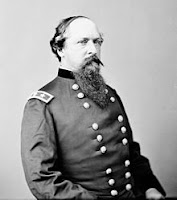
James B. Ricketts
     James B. Ricketts' 2nd Division especially needed a hand. In the recent Northern Virginia campaign, one member of the division speculated, "Our division probably done more marching than any other." The situation within the division was so bad that Ricketts' surgeons banded together and approached the commanding general with the ominous assessment that, in their opinion, "the division was physically unfit for duty."(2)
     The expediency of the dire situation forced by Lee's invasion into Maryland in September 1862 forced the Federals' hand. McClellan had to make use of what he could with what he had. The army's artillery arm was not in good shape. "Many had not been refitted since the August campaign; some had lost more or less guns; others were greatly deficient in men and horses, and a number wholly unserviceable from all these causes combined," wrote Brig. Gen. Henry Hunt, the man responsible for sorting out McClellan's artillery.(3) Certainly, one of those batteries Hunt dealt with was that belonging to Capt. James Thompson's Battery C, Pennsylvania Light Artillery.